
Lately everywhere people talking EV cars lah.
Friends getting BYD, another friend upgrade to Tesla Model Y Juniper, uncles at kopitiam also say BYD rolling out so many models until cannot keep count, and EVs are now more than four in ten new cars in Singapore.
But for us, the real trigger was not trend or FOMO.
It was when our old petrol car quietly hit 8 years old and the COE 10 year expiry suddenly felt very near, which means resale value can drop very fast if just wait and see.
When we knew time to shop
Our petrol car served us faithfully for 8 years, doing school drops, Sheng Siong runs, work commute, and even road trips to Genting, which we covered in detail in this guide on visiting Genting Highlands with kids.
But at 8 years old with only 2 years left before COE expiry, we knew resale value was going to slide faster and faster if we just hold.
Petrol costs were also steady at around S$80 to S$100 a week for school runs, groceries, and commuting.
We always been petrol car fans, because petrol cars feel familiar and easy to maintain.
However, with COE near S$100,000, even normal petrol cars now carry very painful depreciation, so we decided at least must see what EV side got.
Why we end up looking at used EV

We first went to the BYD showroom to see the new Atto 3.
Wah, nice car, modern design, big centre screen, and officially can do about 420 km per charge on WLTP. But when we saw price tags in the S$180,000 to S$190,000 range, the S$18,000 to S$19,000 a year depreciation was too much for our family budget.
Next step, like every Singaporean, we opened Sgcarmart to kaypoh.
That is when we saw some used Atto 3 units with depreciation closer to S$16,000 a year, which suddenly looked more reasonable. There is one advertised on SGCarmart 2 months ago. Now still being advertised.

With EVs making up over 40 percent of new car sales and enjoying strong ARF rebates, the used EV market is finally big enough to find decent cars without paying brand new premium.
That is when we thought, maybe can seriously consider second hand EVs, especially since there is no extra ARF penalty for higher OMV and road tax still has rebates as part of the national EV roadmap. A full breakdown of what we actually paid, including COE, ARF, and loan details, is in Part 1: Buying an EV Car in Singapore – How Much To Pay.
First few weeks living with EV as a family
When we collected the car, my wife straight away commented how quiet it was. Moving off feels like gliding, with only a soft EV sound in the background, similar to an MRT leaving the station but much softer inside the cabin.
The Atto 3 official range is around 420 km, but in real Singapore driving with aircon, kids, and typical traffic, we are seeing about 350 to 360 km per charge, which matches what many tests report.
For our family routine, that range easily covers full day school pickups, market runs, and office commute.
Best part is plugging in at the carpark overnight and waking up with a “full tank”, which can be scheduled and monitored through the BYD app. Boot space is similar to our old hatchback and fits two kids bicycles plus one foldable bike, still with room for bags.
The car felt a bit bouncy on PIE bends in the first week, but after adding some anti roll bar, it became much smoother.
On running cost, we are already saving roughly S$150 to S$200 a month versus petrol once you add up home or public charging versus old fuel bills.
Public charging examples in Singapore show that a 30 percent to 80 percent DC charge on an Atto 3 can cost in the low tens of dollars depending on tariff, which fits what we see. Full charging habits, charger types, and maintenance details are in Part 2: EV Charging Costs, Maintenance and Savings in Singapore.
Real test: Genting and beyond city driving
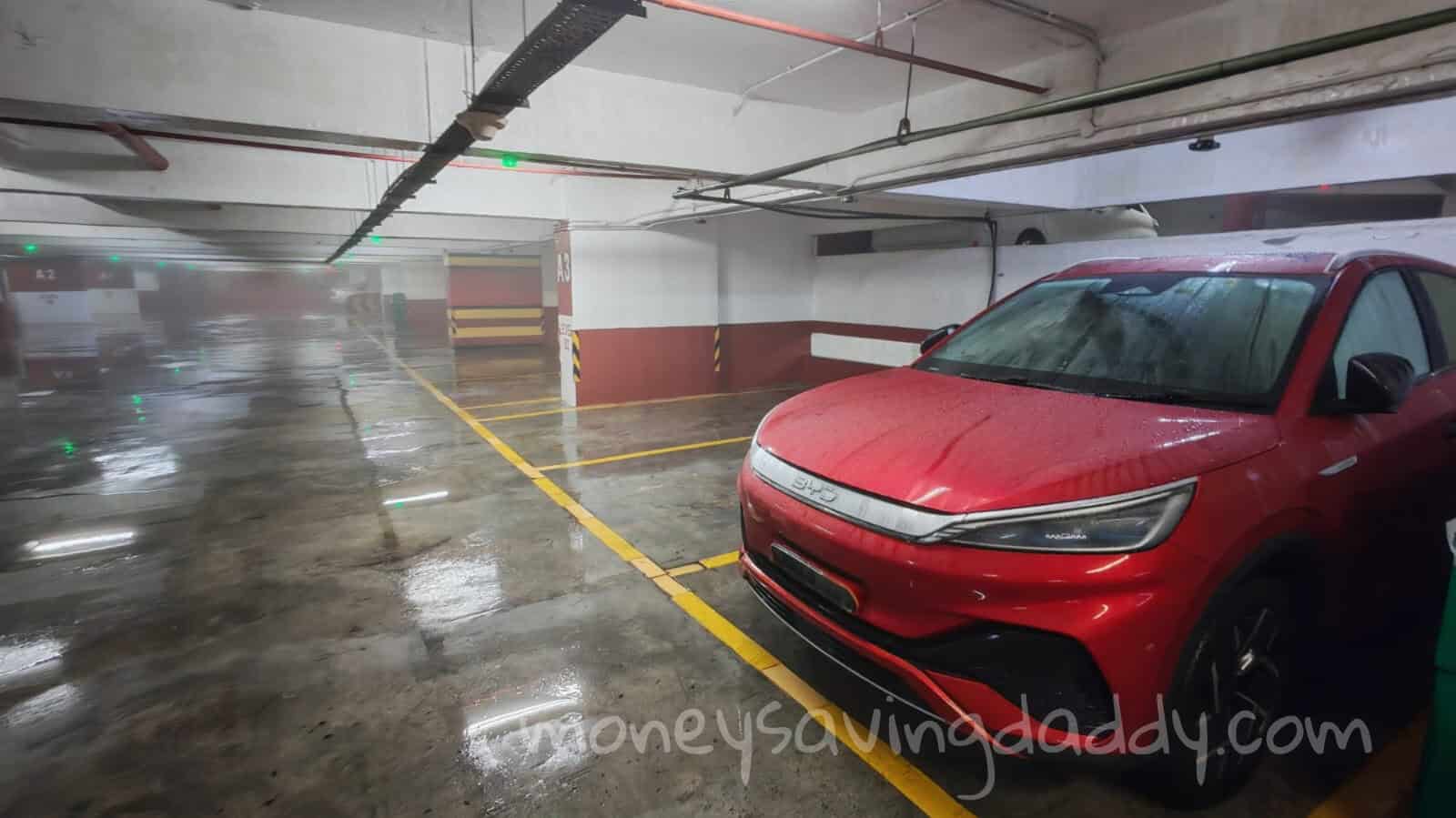
To see the real highway and mountain performance, we took the EV up to Genting.
With full family load, luggage, aircon running the whole time and wet weather, usable range per full charge dropped to around 210 km, which is a big difference from city numbers but normal for this kind of driving.
We stopped four times on the way up, three for EV charging and one for Yong Peng breakfast, so yes, more stops than a petrol car but still manageable with kids.
The Blade Battery LFP pack stayed stable and took repeated fast charges without any heat drama. Our car package came with an 8 year battery warranty, and many newer EVs in Singapore now offer up to 10 year battery warranties, which lines up nicely with a 10 year COE.
The more complicated part is future resale value, since EV tech moves fast and new models can make older ones look outdated sooner, which we cover in Part 3: EV Resale Value in Singapore.
Common EV switch questions People always ask
Range anxiety and getting stuck
The most common question is still range anxiety, especially about getting stuck halfway in JB or on the way to Genting. EVs show an estimated range based on recent driving and consumption, similar to how you mentally track petrol usage from your fuel gauge.
For simple JB runs, the best habit is to charge full before crossing and know at least one or two charging options across the border.
For Genting, more detailed planning is needed, with specific DC charger stops and backups, which we share step by step in our Genting EV road trip guide on the site.
Charging time versus petrol top up
Charging will never be as fast as a 5 minute petrol stop, especially if you are going from low SOC up to 80 percent or more, but the mindset is different.
Think of it like smartphone charging these days, you top up whenever you can, at 60% or 70%, instead of waiting till battery red bar.
Short opportunistic charges at malls, offices, and neighbourhood carparks make EV life much smoother.
Battery and hot weather worries
Modern LFP Blade batteries are engineered for higher thermal stability and are widely used in hot climate markets, which makes them suitable for Singapore and Malaysia conditions.
Over many years there will be some natural degradation, but manufacturers and regulators expect that with regular use, most EV packs will retain a high percentage of capacity over an 8 to 10 year span.
No charger near home yet
Three or four years ago, lack of chargers near home was a real showstopper. Now, operators such as SP Mobility and Charge+ have rolled out thousands of public charging points in HDB, condo, and commercial carparks, and plans aim for tens of thousands more by 2030.
Many estates, malls, and office buildings already have at least a few chargers, so the situation is improving very quickly.
Resale, insurance, and big ticket fears
Resale for EVs is likely to follow a faster cycle than petrol cars, more like phone generations, since a new model with better range and features can push down older models faster.
Insurance premiums for EVs are currently often about 20 to 30 percent higher than similar ICE family cars, as insurers are still building claims data and pricing in repair costs.
Battery replacement is the scary number that everyone throws around, but most owners will be near or at COE decision time when battery warranty ends, so the question usually becomes whether to renew COE or change car rather than whether to change a battery.
If your car also around 8 years old
If your family car is around 8 years old and you can see resale value sliding, it is a good time to start test driving both new and used EV options.
Visit EV showrooms to feel the drive, then use platforms like Sgcarmart to compare depreciation, battery warranty remaining, and loan structure for second hand units.
For us, that S$16,000 depreciation “sweet spot”, long battery warranty, and lower running costs made the numbers work out.
With EV chargers popping up almost everywhere, strong EV incentives, and COE still high, the EV maths in 2025 looks very different from a few years ago, and your next step might start from Part 1, Part 2, and Part 3 of our EV series on moneysavingdaddy.com.